Before the Shutters: The Quiet Curriculum of the UK Sneaker Queue

Photo: *Savaman*, CC BY 2.0, via Wikimedia Commons
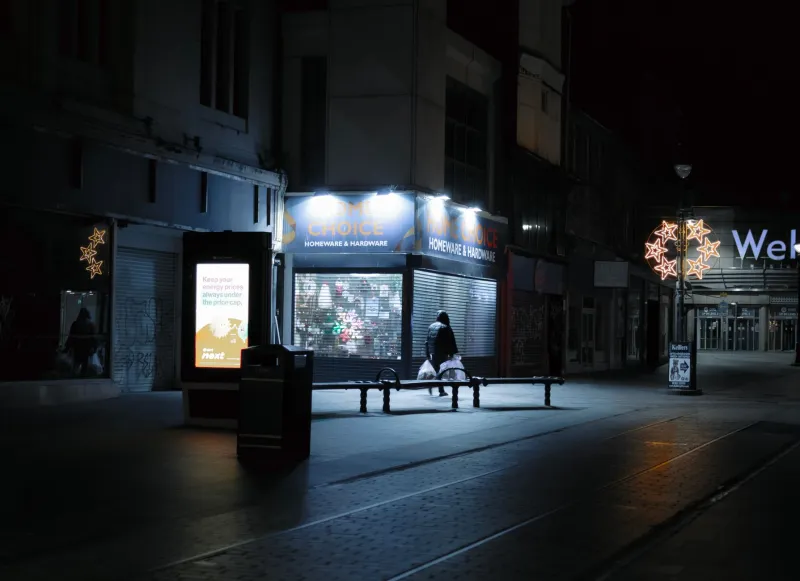
There's a particular sound a UK high street makes at 5:40 on a November morning. Delivery vans reversing. A bin lorry two streets over. Somebody's flask lid clicking shut. And, if you know where to listen, the low murmur of sixty people who have all decided to stand in the cold for the same reason.
By the time the shutters go up, that crowd will have run itself for three hours without a manager, a bouncer or a single printed sign. It will have organised its own order, policed its own behaviour and put on the best-dressed gathering in the postcode. And most of what happens inside the shop will be over in about ninety seconds.
The queue, in other words, is the main event. The drop is just the receipt.
The 5:40 Club
In 2026, the mechanics of a release have never been smoother. Apps handle raffles, accounts handle the wallet, and half the allocation is gone before the kettle's boiled. So why are people still standing on pavements outside Footpatrol, END., Size? and a hundred independent doors from Soho to the Northern Quarter?
Because the in-store allocation is the part the internet can't replicate. A wristband, a number on the back of a hand, a fold-out table with a clipboard. It's the last bit of streetwear that still happens in the open air, and the people who turn up for it know exactly what they're getting: a few hours of company, a decent story, and a fair shot at the pair.
The regulars have it down to a routine. Thermos, power bank, a bag that sits flat against the body, gloves you can still unlock a phone in. Somebody always brings a spare umbrella. Somebody always has a deck of cards. Nobody has ever once been glad they wore the fresh white trainers.
The Dress Code Nobody Wrote Down
Queue style is its own genre, and it's built on one rule: practical first, personality second, logos a distant third.
At 6am in November, fashion is a function of weather. You'll see waterproof shells over vintage fleece, a scarf doing more work than the jacket, hem lengths chosen so they don't drag through puddles. Cross-body bags are everywhere because they keep both hands free for coffee and phones. Caps are optional; hoods are not.
What you won't see much of is the full-look, head-to-toe catalogue fit. The queue has a nose for costume. Standing around for three hours in something you're afraid to crease reads as exactly that — a dress-up. The people who look best in the line are usually the ones wearing the things they'd wear anyway: beaten-up trainers, a good coat, a jacket with a bit of history to it.
It's a quiet flex, and it's a more useful lesson than anything in a lookbook. At ground level, style is about how clothes behave on a real body in real weather, not how they photograph against a white wall.
The Code of Conduct
No queue has a handbook, yet every queue enforces the same rules. It's remarkable, really — a hundred strangers with no authority between them, all agreeing on etiquette by instinct.
The list is sacred. Paper, notes app, numbers on wrists — whatever form it takes, the list decides. Skipping it is the one offence that gets you a genuinely cold shoulder.
No ghost places. A mate can join you, but only if they've actually turned up. Holding a spot for someone still in bed is how a queue turns into a negotiation.
Coffee runs are communal. Whoever's nearest the front does the round. Money changes hands later, loosely, and nobody keeps score too precisely. It's the fastest trust-building exercise in British retail.
Keep the pavement clear. Pushchairs, wheelchairs, bin crews and the bloke trying to open his shop all take priority. The queue bends around real life; it doesn't block it.
Take your cups with you. The line leaves a pavement the way it found it. Almost always.
Respect the staff. The people lifting the shutter have been on the other side of a hyped release more times than anyone in the line. Nobody claps, nobody chants, nobody bangs on the glass. That stuff is for the internet.
No resale talk before the drop. The fastest way to sour a good queue is to turn it into a market. The unspoken deal is that everyone is here because they actually want the shoe.
More Style Per Square Metre Than the Shop Floor
Spend a morning in a queue and you'll clock more genuine styling decisions than you will all day on a feed. The way a fleece sits under a parka. The sock showing above a low-profile trainer. A bag strap shortened with a hairband. A 15-year-old in a hand-me-down jacket standing next to a 40-year-old in the same jacket, and both of them looking right.
It's also where you learn how things age. Inside the shop everything is pristine, tagged and lit. Outside, you're looking at pairs that have done two winters, coats that have been rained on, and bags that have been to a hundred of these mornings. That's the actual review you want before you spend your money.
What You Really Pick Up
Ask anyone who's been doing this a while and they'll tell you the queue was their induction. Not into a brand — into the culture.
You learn sizing, because everyone in the line has an opinion and nobody's shy with it. You learn the difference between a general release and something genuinely limited, because you'll be told, at length, by three different people. You learn which collabs sat on shelves and which vanished, and why. You learn that suede and a British November are natural enemies, and what to do about it.
And you learn patience, which is in shorter supply every year. Three hours of standing around with nothing to buy and nowhere to be is a strange kind of reset. Phones go down eventually. Conversations start. Someone's doing a five-a-side on Thursday and needs a keeper. Someone else is selling a jacket in the group chat. By the time the queue moves, it's less a line than a small, temporary club that happens to be outdoors.
The Drop Is the Excuse
Inside, it's efficient and a bit anticlimactic. You hand over the number, you pay, you take the bag, you're back on the street in under two minutes. The shoe is lovely, obviously. But it's the part of the morning nobody really talks about afterwards.
What they talk about is the bloke who brought a camping stove. The sprint for the doorway when the shutters rattled at 8:59. The list that got rewritten twice. The moment someone's mate turned up with a tray of teas and briefly became the most popular person in the city.
That's the education. Not the product page, not the launch film — the pavement, the flask, the strangers who know exactly why you're there. Streetwear gets its real schooling at 6am, before the shutters lift and the day gets on with itself.